POLICY DOCUMENTPeople
Company Name: Mahavir Bullion & Refinery Private Limited
Policy Title: Staff Safety & Training Policy – RJC COP 2024
Effective Date: 01.04.2025
Approved By: Board of Directors
-
1. Document Control
| Company Name | Mahavir Bullion & Refinery Private Limited | Policy No. | MBR/SRAMP/02 |
| Policy Title | Staff Safety & Training Policy | Revision Date | 01/04/2026 |
| Effective Date | 01/04/2025 | Review Date | 01/04/2027 |
| Approved By | Board of Directors | Approval Date | 23/03/2026 |
| Policy Owner | Compliance Officer / Senior Management | Classification | Controlled Document |
| Applicable Standard | RJC COP 2024 | Next Review | Annually |
-
2. Introduction
Mahavir Bullion & Refinery Private Limited (MBRPL) is committed to maintaining a safe and healthy workplace through safety awareness, competency, training, risk control and continuous improvement. Refinery operations may involve chemical, thermal, physical, machinery, electrical and environmental hazards.
This Policy is based on the Company's original Staff Safety & Training Policy and updates its RJC references to the current RJC COP 2024 framework. COP 24 requires appropriate health and safety systems, worker participation, understandable training and information, PPE, first-aid arrangements, emergency preparedness and incident investigation. -
3. Purpose
• Ensure workers are competent, trained and aware of workplace hazards and controls.
• Reduce accidents, injuries, near misses and unsafe behaviors.
• Establish structured induction, job-specific, refresher and emergency-response training.
• Ensure workers and visitors receive safety information in a format and language they understand.
• Provide appropriate PPE free of charge and verify correct use.
• Ensure safety learning from incidents, near misses and risk assessments is converted into corrective action. -
4. Scope
This Policy applies to permanent, temporary, contractual and outsourced employees, supervisors, managers, department heads, contractors, job workers, security/logistics personnel and visitors entering operational areas, across all shifts and refinery/support functions. -
5. RJC COP 2024 Alignment
| RJC Requirement | Policy Response | Evidence |
|---|---|---|
| COP 24.1 – Workplace health and safety | Safety management, hazard controls, safe workplace requirements and responsibilities. | Risk assessments, inspections, SOPs, corrective actions. |
| COP 24.2 – Risk assessment and controls | Training is linked to job hazards and controls identified through risk assessment. | JSA/JHA, risk register, TNA, training matrix. |
| COP 24.3 – Worker participation | Workers can raise health and safety issues through the safety committee and reporting channels. | Committee minutes, safety observations, grievance records. |
| COP 24.4 – Health and safety training | Role-specific training and emergency information are provided in understandable formats/languages; stop-work responsibility is communicated. | Training records, induction, toolbox talks. |
| COP 24.5–24.8 – PPE, first aid, emergencies and incidents | PPE, first aid, drills and incident investigation are addressed. | PPE records, first-aid records, drill reports, incident investigations. |
-
6. Safety Policy Statement
• Provide a safe working environment and identify hazards proactively.
• Prevent accidents, injuries and unsafe incidents through effective controls.
• Ensure competency of persons performing safety-critical tasks.
• Reduce chemical, thermal, physical, ergonomic and operational risks.
• Provide safety resources, information and PPE appropriate to assessed risks.
• Promote worker participation, hazard reporting and continuous improvement.v -
7. Safety Responsibilities
| Role | Responsibilities |
|---|---|
| Senior Management | Approve the safety programme; provide adequate resources; review safety and training performance. |
| Safety / EHS Officer | Conduct training-needs assessment; maintain training matrix/records; coordinate safety training; oversee PPE, emergency preparedness and chemical safety; investigate incidents. |
| Department Heads / Supervisors | Conduct toolbox talks; verify PPE and SOP compliance; ensure workers complete required training before safety-critical work; report unsafe conditions. |
| Employees | Follow safety rules/SOPs; use PPE; attend required training; report hazards, near misses and unsafe conditions; exercise stop-work responsibility for uncontrolled hazards. |
| Contractors / Visitors | Complete required orientation, follow site rules and PPE requirements, and immediately report unsafe conditions. |
-
8. Training Programme Structure
-
8.1 Induction Training
Mandatory for new joiners before entering high-risk areas. Covers company safety rules, PPE, emergency exits/assembly points/alarms, chemical/thermal/electrical/physical hazards, safety data sheet awareness, first-aid and fire-safety basics, and contractor/visitor safety. -
8.2 Furnace Operators
Molten-metal handling, spill/splash prevention, temperature controls and emergency furnace shutdown. -
8.3 Aqua Regia Operators
Safe acid handling, fume hoods/scrubbers, spill control, reaction control and exothermic hazards. -
8.4 Fire Assay Technicians
Crucibles and fluxes, furnace safety and high-temperature PPE. -
8.5 Maintenance Personnel
Lockout-Tagout, electrical safety and machinery isolation. -
8.6 Chemical Handlers
Correct storage, segregation of incompatible substances, spill kits and disposal procedures. -
8.7 Security & Logistics
Safe handling of precious metals during transport, CCTV/access controls and emergency coordination. -
8.8 Refresher Training
At least annually and additionally after incidents/near misses, process or equipment changes, legal updates or RJC COP updates. -
8.9 Emergency Response Training
Fire preparedness, first aid/CPR, acid-spill response, evacuation, extinguisher use and emergency communications. Mock drills shall be conducted according to the emergency programme and legal/site requirements. -
8.10 Behaviour-Based Safety
Identification of unsafe behaviours, positive reinforcement, peer safety communication and safety-observation reporting. -
8.11 Contractors & Visitors
No entry into operational areas without appropriate safety orientation, PPE briefing, site-hazard awareness and required declaration/acknowledgement.
-
9. Training Needs Assessment (TNA)
The Safety / EHS Officer shall conduct a documented TNA based on:
• Job role and responsibilities
• Hazard exposure and risk level
• Required competency for safety-critical tasks
• Past incident and near-miss data
• Risk assessments/JSA/JHA
• Audit findings and corrective actions
• Legal requirements and applicable RJC COP requirements
• Changes in equipment, process, chemicals or work methods
Training modules shall be reviewed at least annually and updated when risks, processes, legal requirements or RJC requirements change. -
10. Training Matrix and Competency
MBRPL shall maintain a role-based training matrix identifying mandatory training, frequency, responsible trainer and completion status. Safety-critical work shall not be assigned to personnel who have not completed the required training or demonstrated the required competency. -
11. Safety Communication & Awareness
• Toolbox talks and shift safety briefings.
• Safety posters, signs and hazard markings.
• Chemical hazard labels and safety information.
• Safety alerts following incidents or identified hazards.
• Sharing lessons learned and best practices.
• Safety bulletins or other periodic communications as appropriate.
• Communication of workers' right and responsibility to stop or refuse work where hazards are uncontrolled and to immediately raise the concern to those at risk and management, consistent with COP 24.4. -
12. PPE Management
Appropriate PPE shall be provided to workers and visitors free of charge where required by the risk assessment and site rules. RJC COP 24.5 requires PPE to be appropriate, current and correctly worn/used.
• Acid-resistant gloves
• Face shields
• Safety shoes
• Goggles
• Respirators
• Heat-resistant aprons
• Helmets
• Hearing protection
Supervisors shall verify correct use, condition and replacement of PPE. PPE issuance/inspection records shall be maintained. -
13. First Aid & Medical Preparedness
• Maintain appropriate first-aid provisions and trained first-aid personnel.
• Ensure first-aid arrangements are accessible and clearly identified.
• Maintain procedures for transportation to appropriate medical facilities in a medical emergency.
• Record first-aid treatment and work-related injuries as required by law and company procedure.
• Review first-aid arrangements following incidents, workplace changes or risk assessments. -
14. Emergency Preparedness & Drills
Emergency procedures and evacuation plans shall cover reasonably foreseeable health and safety emergencies and shall be accessible/displayed, regularly tested and periodically updated in accordance with COP 24.7.
• Fire/explosion
• Chemical or acid spill and toxic vapour release
• Gas cylinder or utility emergency
• Medical emergency
• Serious equipment/process emergency
• Security-related emergency where worker safety is affected
• Other emergencies identified through the site's risk assessment
Drill results shall be documented, including scenario, date, participants, observations, response time where measured, deficiencies and corrective actions. -
15. Incident, Near-Miss & Unsafe-Condition Reporting
All injuries, near misses, unsafe conditions, chemical spills and relevant equipment malfunctions shall be reported promptly.
1. Immediate notification to the responsible supervisor/Safety Officer.
2. Entry into the Incident/Observation Register.
3. Investigation proportionate to the event, with contributing/root causes identified.
4. Corrective and preventive actions assigned with responsible persons and target dates.
5. Verification of action effectiveness.
6. Lessons learned communicated to affected workers and reflected in training/risk controls where appropriate.
COP 24.8 requires health and safety incidents to be investigated and the results used to review relevant hazard controls and prevent recurrence. -
16. Safety Committee & Worker Participation
Where established, the Safety Committee shall include appropriate management and worker representation and provide a mechanism for workers to raise and discuss health and safety issues and participate in risk assessments and controls, consistent with COP 24.3.
• Review incidents, near misses and safety trends.
• Review workplace inspection findings.
• Discuss worker safety concerns.
• Participate in hazard identification and control improvement.
• Track safety actions to closure. -
17. Monitoring & Review
• Conduct planned workplace safety inspections.
• Track relevant KPIs such as injuries, near misses, training completion and PPE compliance.
• Review training effectiveness and competency gaps.
• Issue corrective/non-compliance notices where appropriate.
• Verify closure and effectiveness of corrective actions.
• Conduct management review at least annually. -
18. Records & Retention
• Training attendance and competency records
• Induction records/certificates
• Training Needs Assessments and training matrix
• Toolbox talk records
• Safety Committee minutes
• Incident/near-miss investigation reports
• JSA/JHA and risk assessment records
• PPE issuance/inspection records
• Emergency drill records
• Corrective-action records
Retention shall follow applicable law and the Company's controlled-record retention requirements. Any period stated in an individual legal or contractual requirement shall be followed where longer. -
19. Policy Violations & Disciplinary Action
Failure to comply with safety requirements may result in corrective action, retraining, removal from safety-critical tasks, suspension or other disciplinary action consistent with company policy, employment terms and applicable law. Serious intentional or reckless violations may be escalated for legal action where appropriate. -
20. Policy Review & Continuous Improvement
This Policy shall be reviewed at least annually and additionally following changes in law, significant new risks, incidents, process/equipment changes, RJC updates or internal/external audit findings.
The Company shall use worker feedback, training performance, incidents, near misses, inspections, risk assessments and audit findings to improve the effectiveness of the safety and training programme. -
21. Related Controlled Documents
• Health & Safety Risk Assessment Policy – RJC COP 2024
• Emergency Evacuation Plan – RJC COP 2024
• Natural Resources Use & Environmental Management Policy – RJC COP 2024
• Security Risk Assessment & Management Policy – RJC COP 2024
• Grievance Redressal Policy – RJC COP 2024
• Human Rights Policy – RJC COP 2024
• Applicable safety SOPs, JSAs/JHAs, training matrix and emergency procedures - For Mahavir Bullion & Refinery Private Limited
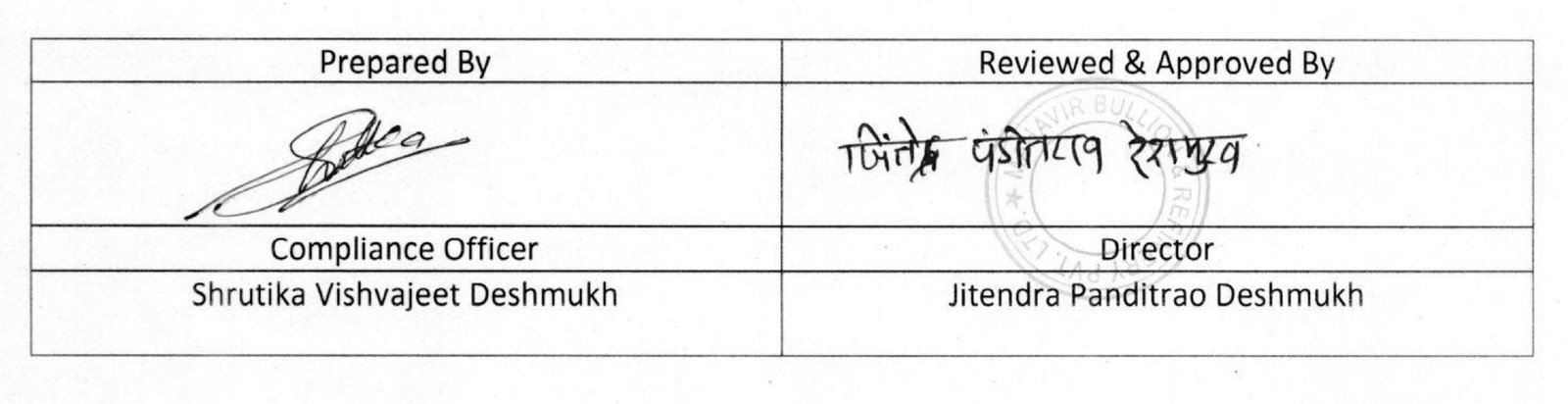
The signature and stamp above are preserved from the published document.
Published source ↗Source reviewed 29 October 2026