POLICY DOCUMENTConduct
Company Name: Mahavir Bullion & Refinery Private Limited
Policy Title: Anti-Bribery & Anti-Corruption Policy
Effective Date: 01-09-2025
Approved By: Board of Directors
Policy Title: Anti-Bribery & Anti-Corruption Policy
Effective Date: 01-09-2025
Approved By: Board of Directors
-
1. Introduction
Mahavir Bullion & Refinery Private Limited (“MBRPL” or “the Company”) conducts its business with integrity, transparency, and accountability. Bribery and corruption undermine ethical business conduct, distort markets, and expose organisations to significant financial, operational, and legal risks.
This Policy establishes MBRPL’s zero-tolerance approach to bribery, corruption, facilitation payments, kickbacks, and all forms of improper advantages. It aligns with:
• RJC COP 2019 – COP 3: Bribery & Facilitation Payments
• Prevention of Corruption Act, 1988
• Prevention of Money Laundering Act (PMLA), 2002
• FATF recommendations
• OECD Anti-Bribery Convention
• Industry best practices for gold refinement & bullion trade
All directors, employees, suppliers, intermediaries, logistics partners, visitors, and any persons acting on behalf of the Company must comply with this Policy. -
2. Purpose of the Policy
The purpose of this Policy is to:
• Prevent MBRPL from being involved in bribery or corruption directly or indirectly.
• Provide clear expectations on acceptable and unacceptable conduct.
• Establish internal controls, procedures, and reporting mechanisms.
• Ensure compliance with RJC COP and relevant Indian laws.
• Protect the Company from reputational, financial, regulatory, and criminal consequences.
• Promote ethical decision-making and accountability across all operations. -
3. Scope
This Policy applies to:
• All employees of MBRPL (permanent, temporary, contractual, trainee, outsourced)
• Directors, senior management, and department heads
• Agents, brokers, job-workers & contractors
• Security staff, logistics partners, transport agencies
• Third-party intermediaries & consultants
• Suppliers, aggregators, miners, and scrap dealers
• Customers and trading partners
This Policy applies to all business activities, including procurement, refining, logistics, marketing, sales, finance, licensing, documentation, regulatory interactions, and third-party engagement. -
4. Definition of Bribery & Corruption
Bribery is the offering, promising, giving, requesting, agreeing to receive, or accepting anything of value intended to:
• Influence a decision
• Secure an improper advantage
• Obtain or retain business
• Manipulate a regulatory, financial, or commercial outcome
Bribes may include:
• Cash or cash equivalents
• Gifts, hospitality, entertainment
• Discounts, credit, or favourable pricing
• Free services or benefits
• Political contributions
• Personal favours
• Undisclosed commissions or kickbacks
• Over-invoicing or under-invoicing
• Payments disguised as “consultancy fees” or “facilitation charges”
Corruption includes abuse of entrusted authority for private gain. -
5. Policy Statement - Zero Tolerance (COP 3.1)
MBRPL strictly prohibits:
• Offering, paying, or accepting bribes
• Extortion or solicitation
• Undisclosed commissions or kickbacks
• “Speed money” or facilitation payments
• Payments to influence regulators, customs, DGFT, police, BIS, or any public authority
• Manipulating assay results or refinery output figures
• Over/under invoicing to conceal illegal payments
• Bribes disguised as gifts, hospitality, travel, sponsorships
• Engaging intermediaries to perform bribery on behalf of the Company
Violations will result in disciplinary action, termination, and legal reporting. -
6. Prohibition of Facilitation Payment (COP 3.2)
Facilitation payments are small payments made to secure or expedite routine government actions such as:
• Clearing goods at Customs
• Obtaining permits or licenses
• Routine inspections
• Utility connections
MBRPL prohibits all facilitation payments, regardless of local customs or expectations. Exception — Life or Safety Risk
If an employee is compelled to make a payment under threat to personal safety:
• The employee must immediately report the incident to their Manager and Compliance Officer.
• The incident must be documented and investigated. -
7. Gifts, Hospitality & Entertainment
Gifts or hospitality must never be given or accepted:
• To influence a business decision
• During tendering, supplier evaluation, or contract negotiation
• From or to government officials
• If they involve cash or gift cards
Permitted (with restrictions):
• Low-value, culturally appropriate gifts (e.g., sweets during festivals)
• Modest business meals or light refreshments
• Branded company merchandise
Prohibited:
• Expensive gifts
• Travel packages or hotel stays
• Entertainment or events unrelated to business
• Personal services
All gifts received must be declared in the Gift Register maintained by the Compliance Department. -
8. Roles & Responsibilities (COP 36–41)
8.1 Board of Directors
• Oversees the integrity and effectiveness of anti-bribery controls.
• Approves this Policy and reviews annual compliance reports.
8.2 Senior Management
• Implements systems to prevent bribery and corruption.
• Ensures adequate resources and training.
8.3 Compliance Officer
• Oversees adherence to this Policy.
• Conducts investigations into bribery allegations.
• Maintains registers for gifts, hospitality, and conflict of interest.
8.4 All Employees
• Must not engage in or tolerate bribery.
• Must report suspected violations immediately. -
9. Third-Party Intermediaries (COP 3.3)
Third parties may include:
• Customs brokers
• Consultants
• Logistics agents
• Introducers
• Gold aggregators
• Government liaison personnel
MBRPL conducts Enhanced Due Diligence on third parties, including:
• Business justification
• Beneficial ownership verification
• Conflict of interest checks
• Sanctions/adverse media screening
• Background verification
No third party may be engaged without a written agreement containing anti-bribery clauses. -
10. Procurement & Supplier Controls (COP 7 & 28–30)
Suppliers must:
• Provide complete KYC/KYB documentation
• Sign Responsible Sourcing Declarations
• Agree to audits and assessments
• Maintain transparent pricing and invoicing
• Not engage in bribery, manipulation, forged documentation, or illegal mining
The Company may terminate a supplier relationship if any violation is identified. -
11. Red Flags (COP 3.4 & OECD ANNEX II)
Examples include:
11.1 Transaction Red Flags
• Unusual discounts or inflated prices
• Requests for off-the-books payments
• Payments routed through unrelated third parties
• Assay manipulation requests
• Pressure to expedite payments without documentation
11.2 Behavioural Red Flags
• Supplier unwilling to sign anti-bribery clauses
• Attempts to bypass internal controls
• Excessive hospitality or gifts offered
11.3 Government Interaction Red Flags
• Requests to pay unofficial “fees”
• Redirected payments
• Officials insisting on using a specific agent
Any red flag requires immediate escalation. -
12. Reporting & Whistleblowing (COP 41)
Employees may report concerns through:
• Compliance Officer
• Internal email (designated)
• Confidential written complaint
Whistleblowers are protected against retaliation, harassment, or adverse employment consequences. -
13. INVESTIGATION PROCEDURE
When a bribery allegation is reported:
• Compliance Officer conducts preliminary assessment.
• If credible, a formal investigation is initiated.
• Evidence is collected confidentially.
• Relevant employees or suppliers may be suspended during investigation.
• Findings are reviewed by Senior Management.
• Corrective and disciplinary actions are implemented.
If necessary, matters may be reported to statutory authorities. -
14. Disciplinary Action
May include:
• Written warning
• Suspension
• Demotion
• Termination
• Supplier blacklisting
• Legal prosecution under PMLA or Prevention of Corruption Act -
15. Training & Awareness (COP 38)
Training includes:
• Annual mandatory anti-bribery training
• Role-specific sessions for procurement, logistics, and compliance teams
• Case studies of real bribery scenarios
• Monitoring of training effectiveness
New employees receive induction training on this Policy. -
16. DOCUMENTATION & RECORD KEEPING (COP 40)
Records maintained for 10 years:
• Gifts & hospitality registers
• Conflict of interest declarations
• Supplier due diligence files
• Investigation reports
• Training attendance logs
• Audit reports
• Contractual agreements -
17. AUDIT & REVIEW (COP 39–41)
Internal audits evaluate:
• Effectiveness of anti-bribery controls
• Adequacy of documentation
• Compliance with RJC COP and Indian regulations
• Corrective action implementation
Findings are reported to Senior Management and the Board.
This Policy is upon:
• RJC COP updates
• Regulatory changes
• New operational risks
• Any findings
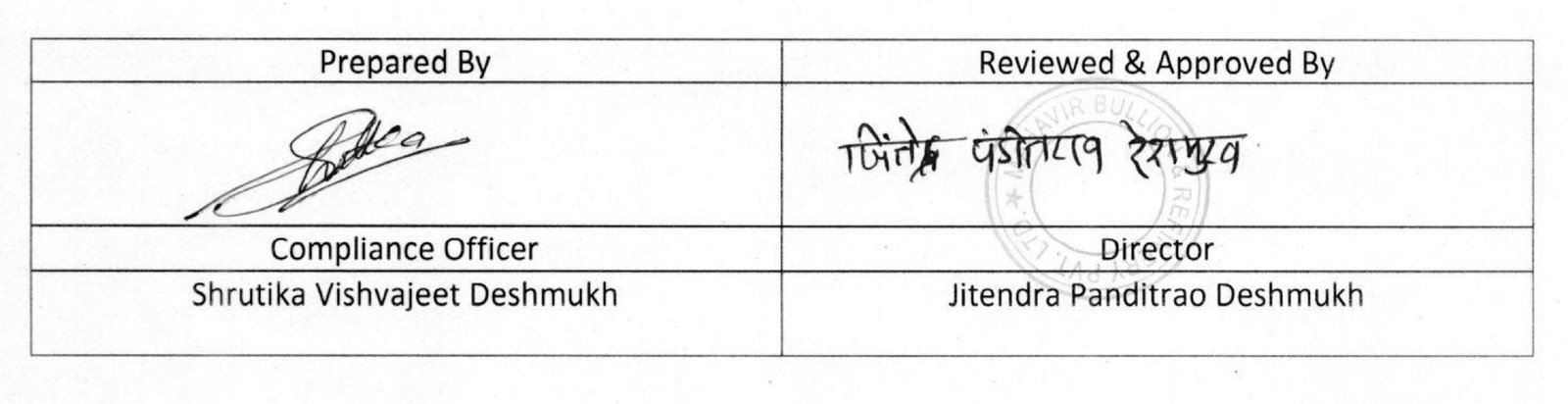
The published page for this policy carries no sign-off image; the company’s standard sign-off is shown. Its approval information is reproduced as written.
Published source ↗Source reviewed 29 October 2026