Natural Resources Use & Environmental Management Policy
MAHAVIR BULLION & REFINERY PRIVATE LIMITED
POLICY DOCUMENTEnvironment
1. Document Control
Company Name
Mahavir Bullion & Refinery Private Limited
Policy No.
MBR/SRAMP/02
Policy Title
Natural Resources Use & Environmental Management Policy
Revision Date
01/04/2026
Effective Date
01/04/2025
Review Date
01/04/2027
Approved By
Board of Directors
Approval Date
23/03/2026
Policy Owner
Compliance Officer / Senior Management
Classification
Controlled Document
Applicable Standard
RJC COP 2024
Next Review
Annually
2. Introduction
Mahavir Bullion & Refinery Private Limited (“MBRPL” or the “Company”) recognises that responsible use of natural resources is essential to sustainable operations and long-term business continuity. Refinery and bullion operations consume water, energy, fuels and chemicals and may generate wastes, effluents and emissions. Therefore, efficient resource use, pollution prevention and regulatory compliance are integral to the Company’s environmental management approach. This Policy is based on the Company’s existing Natural Resources Use & Environmental Management Policy and retains its refinery-specific controls, including water, energy, chemical use, emissions, waste, monitoring, supplier expectations and continuous improvement. It has been updated to reflect RJC COP 2024.
3. Purpose
• Reduce consumption and wastage of natural resources including water, electricity and fuels. • Promote efficient processes, clean technologies and responsible resource use. • Reduce emissions, effluents and the environmental footprint of refinery operations. • Prevent pollution and comply with applicable environmental laws, permits and consent conditions. • Monitor resource consumption and environmental performance through measurable KPIs. • Create awareness, accountability and continuous improvement across the workforce.
4. Scope
• All refinery operations, including melting, aqua regia, fire assay, scrubbing, filtration and dust collection. • Laboratory operations. • Office and administrative facilities. • Utility systems including DG sets, compressors, HVAC and water-purification systems. • Employees, contractors, suppliers, transporters and visitors, where relevant to environmental controls. • All significant natural resources, wastes and emissions associated with Company premises and operations.
5. RJC COP 2024 Requirements Addressed
RJC Provision
Requirement / Expectation
Company Control
COP 25 – Environmental Management
Environmental management appropriate to significant risks and impacts.
Ensure optimal use of utilities and materials and review department-level resource consumption.
Employees
Follow resource-conservation practices and report wastage, leaks, spills or environmental hazards.
7. Principles for Natural Resource Use
• Reduce wastage of resources. • Reuse materials wherever feasible. • Recycle scrap, waste streams and treated water where feasible and lawful. • Recover usable materials from waste streams where feasible. • Replace high-impact materials with efficient alternatives where practical. • Prioritise prevention and reduction before disposal. • Use monitoring data to identify improvement opportunities.
8. Water Management
8.1 Water Use in Refinery
• Cooling systems • Scrubber units • Cleaning of equipment and floors • Employee welfare, sanitation and drinking
8.2 Water Efficiency Measures
• Flow restrictors on taps where appropriate. • Regular leak inspections and prompt repair. • Closed-loop water systems in scrubbers where feasible. • Scheduled cleaning instead of continuous water flow where feasible. • Monthly water-consumption KPIs and trend review.
8.3 Water Quality and Discharge
• Monitor relevant effluent parameters such as pH, TDS and heavy metals as required by consent conditions and applicable law. • Use an ETP where applicable to the operation and consent conditions. • Apply a zero-discharge approach where feasible and legally/technically appropriate. • Maintain records of water quality testing, treatment performance and lawful discharge/disposal.
9. Energy Management
9.1 Energy Consumption Areas
• Furnaces and melting units • Fume-extraction systems • HVAC systems • Compressors and pumps • Lighting and other electrical equipment
9.2 Energy Efficiency Measures
• Use high-efficiency motors and equipment where feasible. • Preventive maintenance of furnaces and utilities. • LED lighting and efficient electrical systems. • Insulation of hot surfaces where appropriate. • Shutdown of idle equipment. • Maintain energy/electricity logs and review trends.
9.3 Fuel Use
• Monitor DG-set fuel consumption monthly. • Maintain DG-set operating and maintenance records. • Use fuel efficiently and investigate abnormal consumption. • Maintain applicable emission and compliance records.
9.4 Greenhouse Gas and Energy Reporting
• Quantify and document annual Scope 1 and Scope 2 greenhouse-gas emissions using a documented methodology. • Record material energy consumption by source. • Identify opportunities for energy efficiency and renewable-energy use. • Where additional RJC requirements apply to the Company, maintain the relevant plan, verification and reporting evidence.
10. Chemical Resource Management
10.1 Key Chemicals Used
• Hydrochloric acid • Nitric acid • Aqua regia • Fluxes, reagents and laboratory chemicals
10.2 Minimisation and Substitution
• Optimise acid mixtures and process quantities to reduce unnecessary consumption. • Recover or control nitric fumes through appropriate scrubber systems. • Use sealed/appropriate chemical storage to minimise evaporation and leakage. • Maintain chemical inventory and FIFO controls where appropriate. • Evaluate safer or lower-impact alternatives where technically feasible.
10.3 Safe Handling
• Maintain current SDS/MSDS and make them accessible in relevant work areas. • Use acid-resistant PPE and other controls required by the risk assessment. • Provide secondary containment for relevant chemical storage. • Control spills through established spill-response procedures. • Maintain chemical inventories and inspection records.
11. Waste Management
• Identify and classify hazardous and non-hazardous wastes generated by refinery and support activities. • Segregate wastes at source and prevent incompatible waste mixing. • Apply the waste hierarchy: reduce, reuse, recycle and recover where feasible before disposal. • Use authorised vendors/transporters for regulated waste disposal. • Maintain manifests, disposal receipts and other evidence required by applicable law. • Monitor waste quantities and investigate opportunities for reduction.
12. Emissions and Air Quality Management
12.1 Air Emission Sources
• Furnace fumes • Acid vapours from aqua regia • DG-set emissions • Dust from relevant processing areas
12.2 Control Measures
• Wet scrubbers for acid vapours where applicable. • Regular monitoring of relevant air-emission parameters as required by consent conditions. • Stack monitoring as applicable under MPCB requirements. • DG-set emission compliance records where applicable. • Maintenance of pollution-control equipment.
12.3 Indoor Air Quality
• Adequate ventilation. • Fume hoods in chemical areas where required. • Dust-collection systems in filing/grinding areas where applicable. • Prompt investigation of abnormal fumes, odours or air-quality concerns.
13. Noise, Odour and Nuisance Control
• Acoustic enclosures or equivalent controls for DG sets where required. • Hearing protection in designated high-noise areas. • Preventive maintenance of scrubbers and pollution-control equipment to control odour. • Investigate complaints or abnormal nuisance conditions and implement corrective actions.
14. Natural Capital, Land and Soil
For activities within Company premises, MBRPL shall consider whether operations create significant adverse impacts on land, soil or related natural capital. Where significant impacts are identified, the Company shall establish appropriate controls, monitoring and corrective actions.
• Identify risks of soil or land contamination from chemicals, fuels, waste and spills. • Maintain suitable chemical and waste storage controls and secondary containment. • Investigate significant spills or contamination and implement corrective action. • Consider relevant land users, neighbouring stakeholders and regulatory authorities where an impact may affect them. • Maintain records of incidents, remediation and monitoring where applicable.
15. Environmental Emergency Preparedness
• Maintain spill-response and environmental-emergency procedures appropriate to refinery hazards. • Maintain suitable spill kits, containment materials and emergency equipment. • Train relevant employees on chemical spills, releases, fire and other environmental emergencies. • Investigate significant environmental incidents and implement corrective/preventive actions. • Coordinate environmental emergency arrangements with the Emergency Evacuation Plan and Health & Safety Risk Assessment Policy.
16. Training and Awareness
• Efficient use of water and energy. • Waste minimisation and segregation. • Chemical handling and spill response. • Environmental emergency preparedness. • Applicable MPCB/environmental compliance requirements. • Resource-conservation and pollution-prevention practices. • Role-specific environmental responsibilities.
Training records shall identify the training topic, date, participants and trainer/competent person, as applicable.
17. Monitoring and Measurement
Indicator / Record
Frequency / Control
Water consumption
Monthly monitoring and trend review
Electricity / energy consumption
Monthly monitoring and annual consolidation
DG-set fuel consumption
Monthly log / operational record
Waste generation
As generated, with periodic trend review
Emission test / stack reports
As required by consent and applicable requirements
Scrubber performance
Routine inspection / maintenance records
ETP performance, if applicable
As required by process, consent and applicable law
Scope 1 & Scope 2 GHG emissions
Annual quantification and documented methodology
Environmental performance results shall be reviewed by responsible management and significant deviations shall result in investigation and corrective action.
18. Supplier and Contractor Expectations
• Provide environmentally appropriate materials and comply with applicable requirements. • Provide current SDS/MSDS for relevant chemicals. • Comply with hazardous-waste handling and disposal requirements. • Use authorised waste-management and transport arrangements where required. • Transporters and service providers shall comply with applicable environmental and safety requirements. • Material environmental non-compliance may result in corrective action, suspension or disengagement subject to the applicable contract and Company procedure.
19. Legal and Regulatory Compliance
The Company shall maintain a current legal and regulatory compliance register covering applicable environmental requirements, permits, consent conditions and authorisations. The original Policy identifies the Environmental Protection Act, 1986; Water (Prevention & Control of Pollution) Act, 1974; Air (Prevention & Control of Pollution) Act, 1981; Hazardous Waste requirements; and MPCB Consent to Operate/authorisation conditions as relevant frameworks. The Company shall update its legal register when applicable legislation or consent conditions change.
20. Records and Document Retention
• MPCB consents, authorisations and compliance submissions. • Water and energy usage logs. • Fuel records. • Calibration and monitoring records. • Hazardous-waste manifests and disposal receipts. • Air, water and effluent test reports. • Chemical inventory and SDS/MSDS records. • Scrubber and pollution-control equipment records. • Environmental training records. • Environmental audit and inspection reports. • GHG calculations and energy-consumption records. • Corrective-action and incident records.
Records shall be retained in accordance with applicable law and the Company’s document-retention controls.
21. Policy Breach and Corrective Action
• Warning, corrective instruction or retraining for appropriate cases. • Corrective and preventive action with assigned responsibility and target dates. • Suspension from specific operations where necessary to control risk. • Supplier or contractor corrective action, suspension or disengagement where appropriate. • Escalation to regulatory authorities where legally required. • Management review of significant or repeated non-compliance.
22. Continuous Improvement
• Set annual environmental and resource-efficiency objectives where appropriate. • Review water, energy, waste, emissions and GHG performance indicators. • Conduct internal reviews and support external audits/assessments. • Evaluate initiatives such as solar/renewable energy, recycling, rainwater harvesting and process-efficiency improvements where feasible. • Encourage employee suggestions for conservation and pollution prevention. • Use monitoring, incidents, complaints and audit findings to improve controls.
23. Policy Review and Approval
• This Policy shall be reviewed at least annually. • Additional review shall occur when operations, processes, equipment or significant resource use changes; environmental incidents occur; applicable laws/consent conditions change; RJC requirements change; audit findings identify gaps; or other material environmental risks arise. • Changes shall be approved through the Company’s document-control and governance process.
24. Related Controlled Documents
• Health & Safety Risk Assessment Policy • Staff Safety & Training Policy • Emergency Evacuation Plan • Risk Mitigation Plan • Responsible Gold, Silver & PGM Sourcing Policy • Chemical / Hazardous Substance procedures • Waste Management / Hazardous Waste procedures
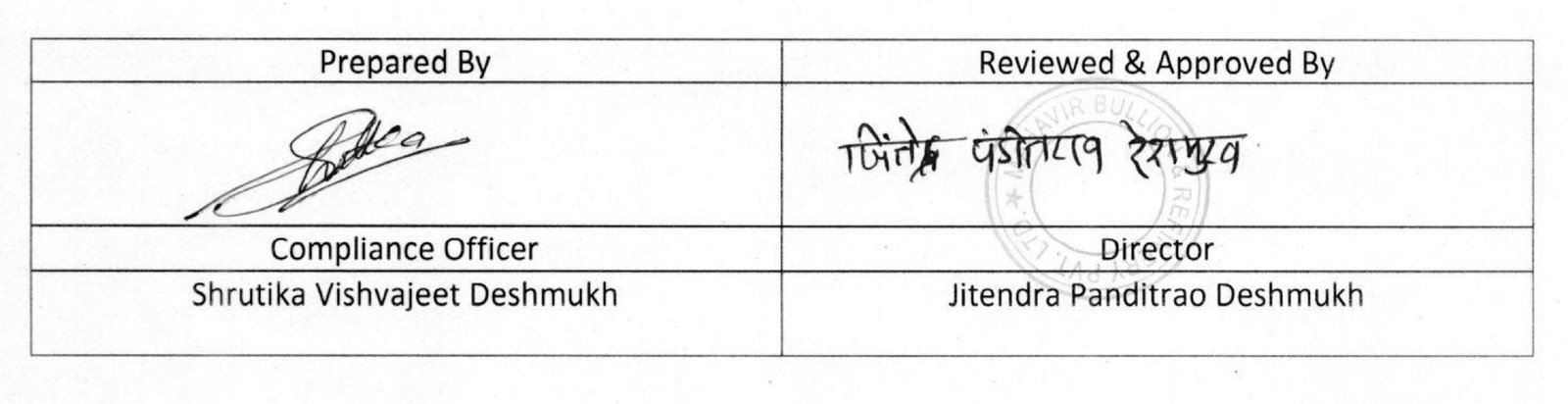
For Mahavir Bullion & Refinery Private Limited
Original sign-off image published with this policy.
The signature and stamp above are preserved from the published document.